
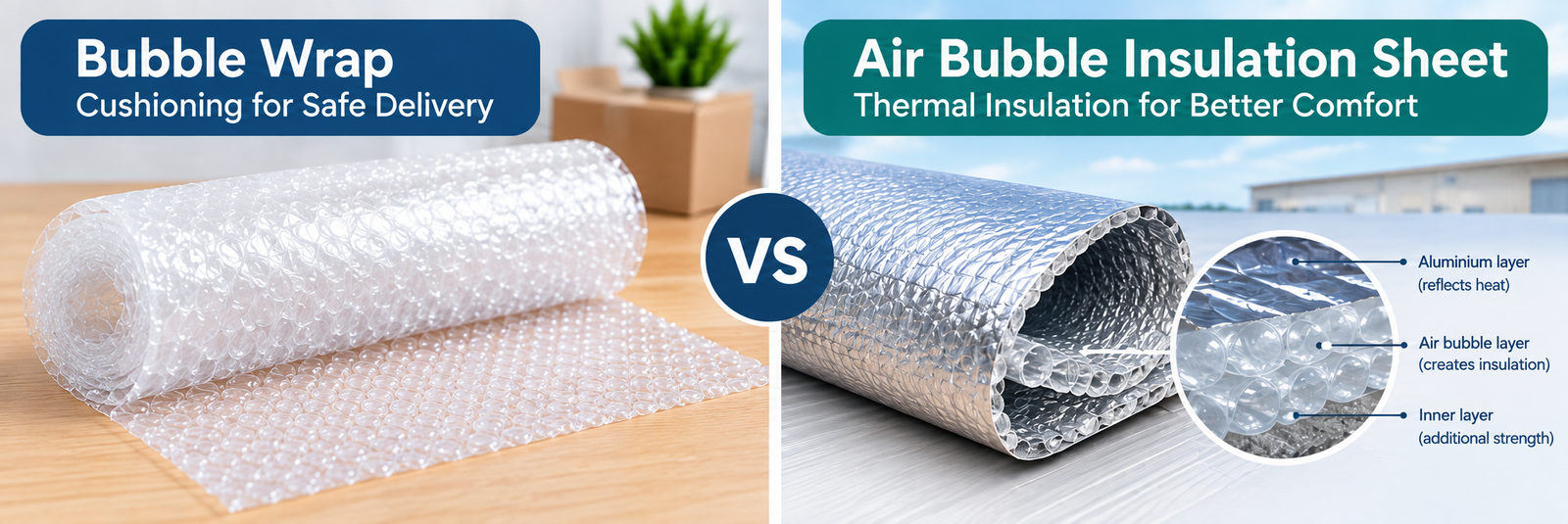
Bubble-based materials are commonly used in packaging, construction, storage, and industrial applications. However, two similar-looking materials can serve very different purposes. For example, bubble wrap cushions items during handling and transport, while an air bubble insulation sheet helps reduce heat transfer in insulation projects.
Choosing the right option involves more than appearance. Consider its structure, layers, thickness, and surface material, as well as what you’ll use it for, since these factors affect how well it works.
Understanding these differences helps in choosing the right materials for roofs, warehouses, industrial spaces, packaging, or other applications. This guide explains how they work, their common uses, and important checks to consider before making a purchase.
What is an air bubble insulation sheet and its function?
An air bubble insulation sheet is a lightweight insulation material made with air-filled bubble layers. The trapped air helps slow heat transfer through the material.
Depending on its construction, the sheet may have additional layers, with some using aluminium or reflective surfaces to better reflect radiant heat.
Common applications include:
- Roof and ceiling insulation
- Wall insulation
- Warehouses and storage facilities
- Industrial buildings
- Temporary structures
- Duct and equipment insulation
- Applications requiring lightweight thermal insulation
An aluminium air bubble insulation sheet has a reflective surface that reflects radiant heat, making it useful for reducing heat gain.
What are bubble wrap and its uses?
Bubble wrap is flexible plastic packaging with air bubbles used to cushion products and protect against knocks, pressure, and movement during transport.
It is commonly used for:
- Glass and ceramic products
- Electronic items
- Decorative products
- Furniture
- Small machinery components
- E-commerce shipments
- Household items during relocation
Bubbles form a soft protective layer, making bubble wrap ideal to prevent scratches, surface damage, and minor impacts.
Air bubble insulation sheet vs bubble wrap: How do they differ?
The main differences are their purpose, construction, and application.
Feature | Air Bubble Insulation Sheet | Bubble Wrap |
Primary purpose | Thermal insulation | Product cushioning |
Main function | Helps slow heat transfer | Helps absorb minor impacts |
Construction | Often includes multiple layers | Usually plastic film with air bubbles |
Reflective layer | Available in selected products | Generally, not present |
Heat control | Designed for insulation applications | Limited |
Common applications | Roofs, warehouses, industrial spaces | Packaging and transportation |
Main concern addressed | Heat transfer | Physical protection |
Typical format | Sheets and rolls | Rolls and flexible sheets |
The right option depends on the problem. Bubble wrap is better for cushioning, but an air bubble insulation sheet is designed for thermal insulation.
How does an aluminium air bubble insulation sheet help control heat?
An aluminium air bubble insulation sheet combines air pockets with a reflective aluminium surface. Each part of the construction can contribute to its insulation function.
The basic working process can be understood in four steps:
- Heat reaches the outer surface: Heat contacts the sheet from the environment.
- The reflective layer interacts with radiant heat: Aluminium surfaces reflect radiant heat.
- Air pockets create a barrier: The trapped air slows heat transfer through the sheet.
- The insulated area gains a thermal barrier: This helps reduce heat transfer.
Actual performance depends on product construction, thickness, installation, conditions, and the overall insulation system.
When is bubble wrap the better choice?
Bubble wrap is generally suitable when product protection is the primary requirement.
Consider bubble wrap when:
- Fragile products need cushioning.
- Items need protection during transportation.
- Surfaces are vulnerable to scratches.
- Products may experience minor knocks.
- You’re packing glass or ceramic items.
- E-commerce products need lightweight protective packaging.
- Household goods are being packed for relocation.
For example, you can wrap a glass item in bubble wrap before placing it in a box. The air-filled bubbles cushion the item between it and the packaging.
However, don’t choose bubble wrap simply because it contains air bubbles. Its construction is primarily intended for physical protection rather than dedicated thermal insulation.
When is an air bubble insulation sheet more appropriate?
Consider an air bubble insulation sheet when reducing heat transfer is an important part of the application.
It may be suitable for:
- Roof insulation: Creates an additional barrier between the roof surface and the interior.
- Ceiling applications: Can be used where lightweight thermal insulation is required.
- Warehouse spaces: Helps address heat transfer through suitable surfaces.
- Industrial areas: Consider for applications exposed to heat.
- Reflective insulation: An aluminium air bubble insulation sheet reflects radiant heat.
- Specialised packaging: Some products need insulation and protection.
Always select the right material based on the application’s actual requirements, not appearance alone.
What product specifications should buyers check?
Selecting an insulation sheet requires attention to more than its price or appearance. Buyers should review the product specifications before placing an order.
Important factors include:
- Sheet thickness
- Bubble size
- Number of layers
- Reflective coating
- Aluminium layer
- Material strength
- Flexibility
- Sheet or roll dimensions
- Installation requirements
- Intended application
- Manufacturer’s technical specifications
Buyers should request clear specifications from air bubble insulation sheet manufacturers to compare options and find the right one for their needs.
How can you evaluate an air bubble insulation sheet manufacturer?
The manufacturer can have an important role in maintaining consistent product quality. Differences in raw materials, layer bonding, bubble formation, and manufacturing controls can affect the final product.
Before choosing an air bubble insulation sheet manufacturer, consider:
- Consistency in sheet thickness
- Uniform bubble formation
- Quality of layer bonding
- Quality of the reflective surface
- Raw material standards
- Product dimensions
- Available sheet specifications
- Quality control practices
- Application-specific product options
It is also better to compare technical specifications than to choose a product based only on price. A suitable product should match the conditions and requirements of the intended application.
Which material should you choose for your application?
The choice becomes simpler when the main purpose is clear.
Choose bubble wrap when:
- Cushioning is the main requirement.
- Fragile products need protection.
- You need protection from minor impacts.
- Products are being transported or stored.
Choose an air bubble insulation sheet when:
- Thermal insulation is the priority.
- You need to reduce heat transfer.
- Reflective heat control is required.
- You are working with roofs, ceilings, warehouses, or industrial spaces.
- You need a material designed for insulation, not simple cushioning.
In simple terms, bubble wrap is primarily a protective packaging material, whereas an air bubble insulation sheet is intended for insulation-focused applications.
Making an informed choice between bubble wrap and insulation sheets
Bubble wrap and insulation sheets may both use trapped air bubbles, but they serve different needs. Bubble wrap mainly cushions products against minor physical damage. Insulation sheets help manage heat transfer, while an aluminium-faced option can also provide reflective heat control.
Before selecting a product, buyers should consider the intended application, construction, thickness, layers, reflective properties, and manufacturer’s specifications. This helps ensure the selected material suits the job.
Packitup offers insulation solutions for buyers looking for products suited to different applications. Those comparing options can review the available specifications and select an appropriate air bubble insulation sheet based on their requirements.
Explore Packitup’s insulation sheet solutions and find the right option for your application.