
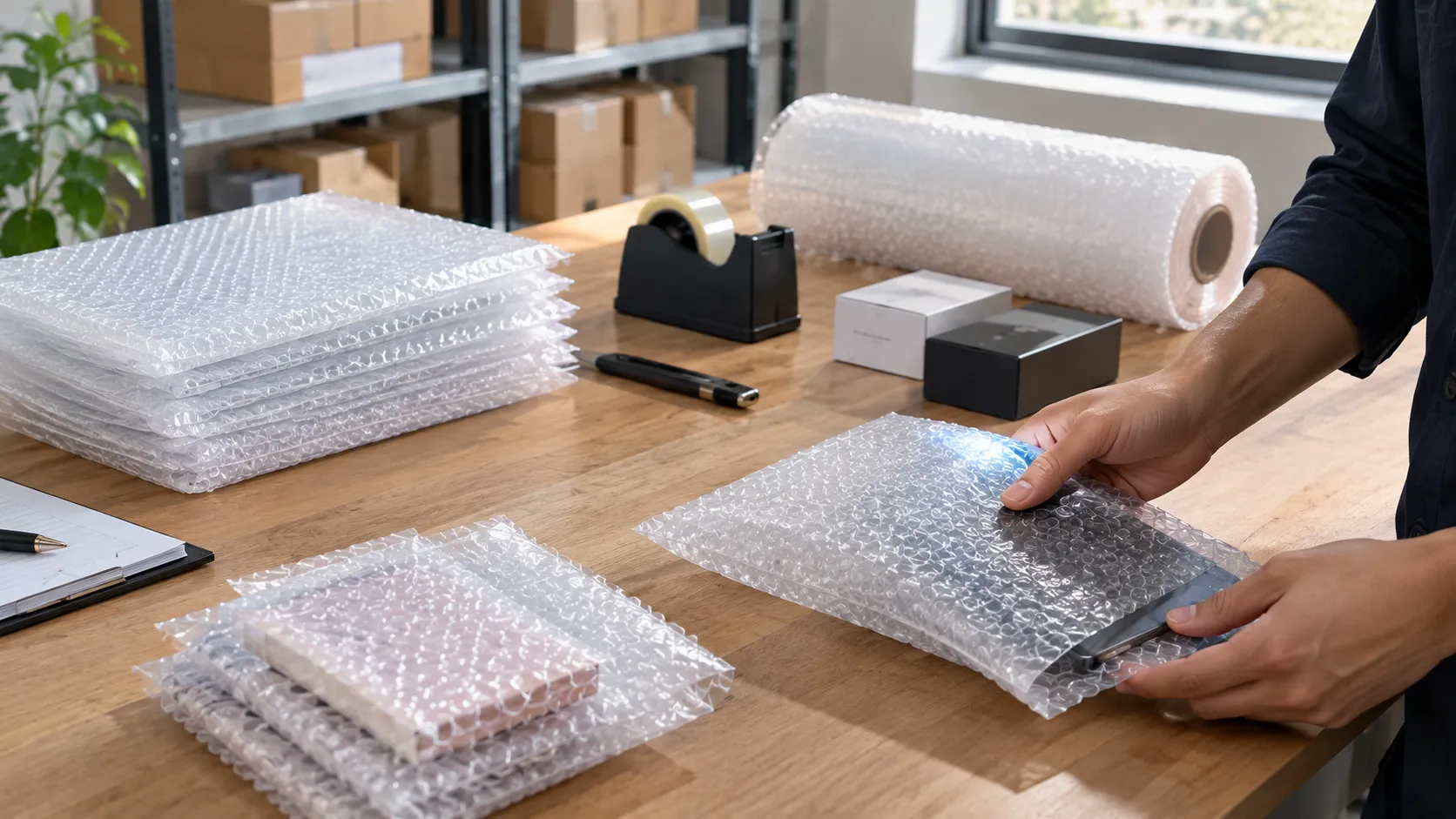
Fragile products need more than a box to reach customers safely. Glass items, electronics, cosmetics, small components, and other delicate products can get scratched, dented, or damaged during transit. Bubble pouches add a layer of cushioning around these products and can also make packing easier.
But not every bubble pouch offers the same level of protection. Differences in film quality, bubble size, pouch strength, and sealing can affect performance. This is why businesses should take some time to compare a bubble pouch manufacturer before placing a regular or bulk order.
What should you check before choosing a bubble pouch manufacturer?
Start by looking at what the manufacturer can actually provide for your products. A supplier that works well for one type of business may not have the right pouch specifications for another.
Keep these points in mind:
- Material: The film should be strong enough for the product and its handling conditions.
- Bubble quality: Look for evenly formed bubbles without obvious weak or flat sections.
- Pouch construction: Seams and edges should hold up during packing and movement.
- Available sizes: Check whether the manufacturer has sizes suitable for your product range.
- Custom options: Custom dimensions can be useful when standard sizes leave too much empty space.
- Order capacity: Make sure the manufacturer can manage your usual order volume.
- Lead time: Ask how long production normally takes before confirming an order.
It is also worth checking whether the bubble pouch manufacturer can maintain the same specifications when you reorder. Consistency becomes important once the pouches become part of your regular packing process.
How important is the material used in bubble pouches?
Plastic film and air bubbles provide the basic cushioning. If either is poorly made, the pouch may not protect items well during handling.
Instead of judging a pouch only by its appearance, check:
- Film thickness
- Bubble size and spacing
- Pouch flexibility
- Resistance to tearing
- Strength of the sealed edges
- Overall finish
The appropriate material also varies based on what you are packing. A lightweight product may not need the same pouch construction as a heavier or more delicate item.
For this reason, businesses should ask an air bubble pouch manufacturer about the material specifications before ordering large quantities. Getting a few samples first can also help you check the fit and performance with the actual product.
Can you get bubble pouches in the size you need?
The pouch should fit the product without making packing unnecessarily difficult. If there is too much empty space, the product may move around inside the pouch. If the pouch is too tight, inserting or removing the product can become inconvenient.
Before choosing a manufacturer, measure the products you pack and consider:
- Product length and width
- Product height or thickness
- Extra space needed for easy insertion
- Required bubble thickness
- Type of closure
- Whether different product sizes need different pouch dimensions
Custom sizing can be especially useful for businesses with products that don’t fit standard pouch dimensions. Ask the air bubble pouch manufacturer whether they can produce different sizes and whether custom orders have a different minimum quantity.
How can you check the manufacturer’s quality and production process?
A sample can tell you a lot about the product, but it doesn’t always show how consistently the manufacturer will maintain that quality across hundreds or thousands of pouches.
Before finalising an order, ask the manufacturer about:
- Raw material specifications
- Production capacity
- Quality checks
- Pouch dimension tolerances
- Bubble consistency
- Sealing quality
- Sample approval
- Production timelines
This is especially important for businesses that place repeat orders. If thickness or dimensions change from one batch to another, workers may struggle to pack products the same way each time.
A manufacturer should also be able to clearly explain what happens if a delivered batch does not match the agreed specifications.
What should you compare when looking at bubble pouches suppliers?
Price is typically among the first factors businesses evaluate. However, the lowest quotation may not provide the lowest overall packaging cost.
For example, weaker pouches may get damaged during handling or require additional protective material. A slightly higher price can reflect better materials or more suitable specifications.
When comparing bubble pouches suppliers, look at the full offer:
| What to Compare | Why It Matters |
| Pouch price | Helps calculate the overall packaging cost |
| Material thickness | Affects the pouch’s strength and cushioning |
| Pouch size | Determines how well the product fits inside |
| Bubble size | Influences cushioning and flexibility |
| Minimum order quantity | Helps manage storage and cash flow |
| Customisation | Useful when standard sizes do not suit the product |
| Lead time | Helps with production and inventory planning |
| Repeat-order capacity | Important for businesses with regular packaging needs |
Ask every supplier for comparable specifications. Comparing two prices without checking the material and pouch dimensions can give a misleading picture.
What questions should you ask before ordering?
A short conversation with the manufacturer can clear up many questions before money is spent on a bulk order.
Ask:
- What material and thickness options are available?
- Which pouch sizes are available as standard?
- Can the dimensions be customised?
- What is the minimum order quantity?
- Could you provide samples prior to placing a bulk order?
- How are the pouches checked during production?
- What is the usual production time?
- Can you maintain the same specifications for repeat orders?
- Are there options for different bubble sizes or pouch constructions?
These questions are particularly useful when comparing several bubble pouches suppliers. They give you a better basis for comparing actual products instead of relying on price alone.
How can you tell if a manufacturer fits your requirements?
Once you have collected the details, compare them against your actual packaging needs. No single pouch specification works for every product.
A suitable bubble pouch manufacturer should be able to meet most of the following requirements:
- Pouch dimensions match the products being packed.
- Film strength suits handling and transportation.
- Bubbles remain properly formed across the pouch.
- Seams and closures are secure.
- Samples match the required specifications.
- Custom sizes are available when standard options do not work.
- Production capacity matches your order volume.
- Delivery schedules fit your packing requirements.
- Repeat orders can be supplied with consistent specifications.
It is also sensible to think beyond the first order. If your business is growing, your packaging requirements may increase too. Choosing a manufacturer that can support larger or recurring orders can save time later.
Choosing packaging that works for your products
The right bubble pouch fits the product, provides the protection it needs, and works smoothly within your packing process. Consider material, size, bubble quality, production consistency, order quantities, and delivery schedules before deciding.
Businesses should therefore compare bubble pouch manufacturer options based on their actual packaging requirements rather than choosing only on price. Samples and clear product specifications can make this comparison much easier.
Packitup offers bubble pouch solutions for businesses looking for protective packaging for different products and packing requirements. You can choose from its range based on the size, material, and protection needs of the products being packed.
Explore Packitup’s bubble pouch options and find the right fit for your packaging requirements.